
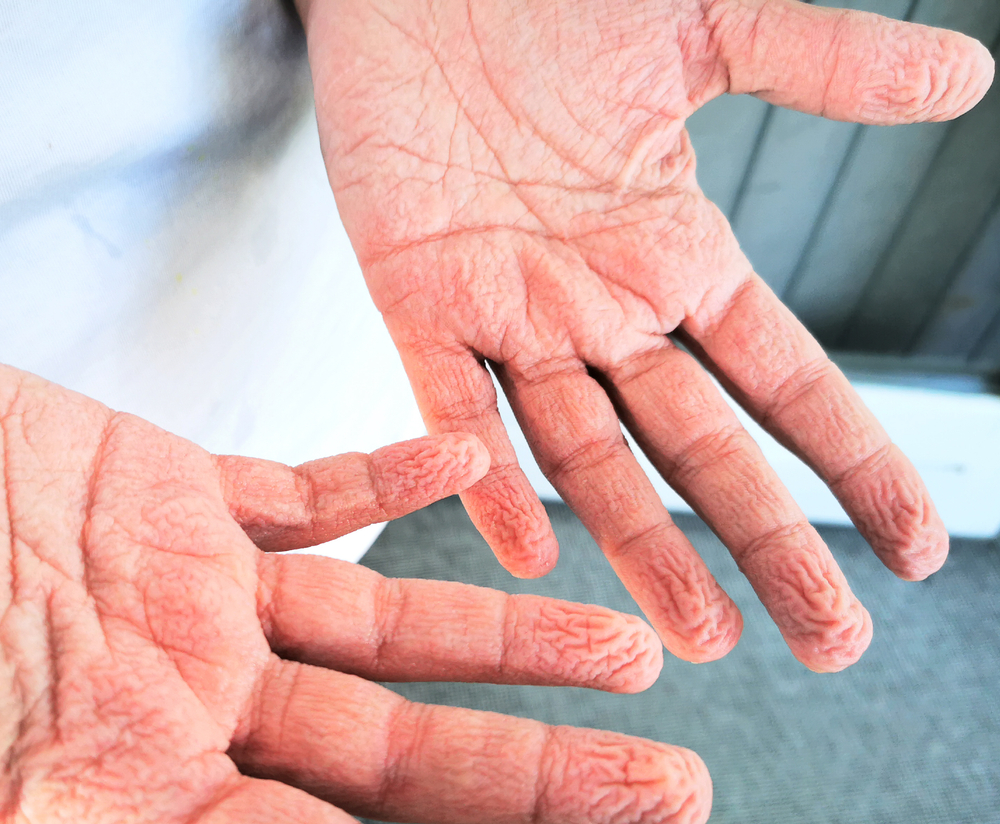
Wrinkled fingers after water exposure — a surprising nervous system response that enhances grip in wet conditions.
We’ve all noticed it—after a long bath, a swim in the ocean, or even just washing dishes for a while, our fingers and toes get strangely wrinkled. But have you ever stopped to wonder why? For a long time, the answer seemed obvious. Now, scientists believe this is not just a passive reaction; it’s a sophisticated and surprising reflex.
The Scientific Explanation
For decades, the prevailing belief was that water simply seeped into the skin’s outer layer, the epidermis, causing the cells to swell and create the prune-like appearance. However, recent research has revealed that this explanation is only half the story. The wrinkling is actually an active process controlled by your nervous system. Specifically, it’s a function of your autonomic nervous system, which handles involuntary actions like your heartbeat, breathing, and now we know, this skin response.
When your skin is submerged in water for several minutes, tiny sensors in your fingertips signal the nervous system. In response, the blood vessels directly beneath the skin constrict—a process called vasoconstriction. This reduction in blood volume causes the skin on the surface to pull inward and tighten, creating the familiar folds and wrinkles. It’s an intentional, neurologically-driven reaction, not just a passive water-logging.
An Evolutionary Advantage?
So, if it’s an intentional process, what’s the point? Scientists now believe this wrinkling might serve a crucial purpose. The wrinkles create tiny channels and grooves that significantly improve grip on wet or slippery surfaces, much like the treads on a car tire or the soles of a hiking boot. It’s an evolutionary adaptation that would have been a significant advantage for early humans. Someone who could better handle wet tools, forage for food in streams, or climb slippery rocks would have had a better chance of survival. This theory suggests our hands are biologically engineered for the specific purpose of maintaining traction in wet conditions.
Tested in Labs
This “traction theory” isn’t just a hypothesis; it has been tested and supported by experiments. In one study, researchers had participants transfer marbles and fishing weights from one container to another. They performed the task first with dry hands, and then again after soaking their hands for 30 minutes to get them wrinkled. The results were clear: participants with wrinkled fingers were significantly faster and more effective at handling the wet objects. The same advantage did not apply to handling dry objects, which further supports the idea that the wrinkling is a specific adaptation for wet conditions.
Does It Happen to Everyone?
The most compelling evidence that wrinkling is a nervous system response, and not just passive swelling, comes from a simple medical observation. Doctors have long known that if a person has certain nerve disorders or if the nerves in their fingers are damaged, their fingers won’t wrinkle in water. Without the neural signal to constrict the blood vessels, the body’s ancient grip-enhancing trick can’t activate. This is the definitive proof that the process is controlled by the nervous system and is not merely an effect of water on skin.
Takeaway
So next time your fingers look like raisins after a shower, remember—it’s not just simple water absorption. It’s your brain activating a sophisticated, evolutionary trick. It’s a reminder of a powerful, ancient adaptation designed to help you get a better grip on a slippery world.
About the Author


